
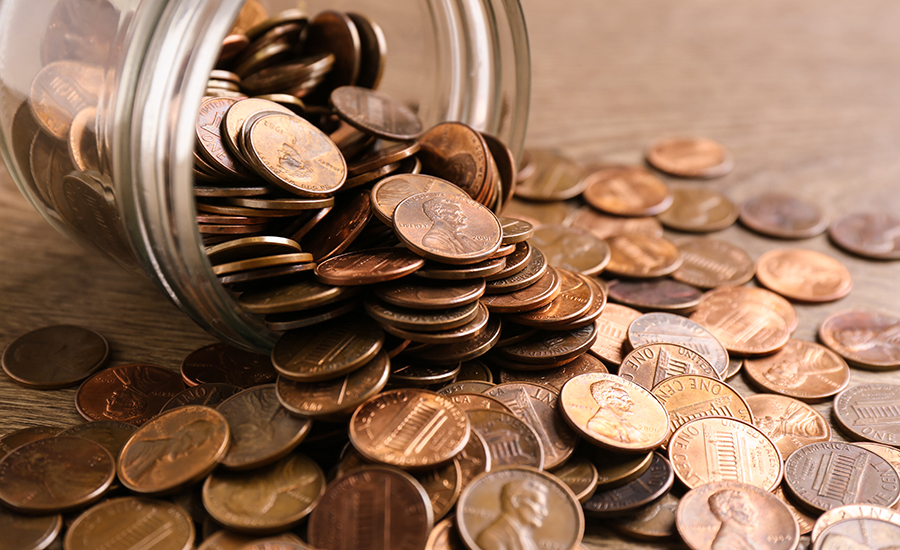
A penny for your thoughts. A penny saved is a penny earned. Penny-pincher. Pennies from heaven. We’ve built a lot of sayings around the penny—but is it worth celebrating? Someone thought so. Every year on April 1, National 1-Cent Day gives a little spotlight to the penny, our smallest unit of U.S. currency.
The penny is one of the only U.S. coins with a holiday dedicated to it (in fact, it has two holidays), and yet unwanted pennies pile up in the “leave-a-penny” dishes near cash registers. They end up forgotten in couch cushions, change jars, and cupholders. Some are simply thrown away—contributing to an estimated $68 million in coins that end up in landfills each year.
But the lowly penny has a long history, and even today, it still has a way of adding up.
A Quick History of the Penny
The U.S. penny has been around since 1793, making it one of the oldest forms of currency still in use today. Over time, the penny became more than just pocket change—it became a symbol of thrift, luck, and small wins, woven into sayings, nursery rhymes, and everyday expressions.
For more than a century, a penny had real spending power. In the early days of U.S. currency, a single cent could buy everyday essentials—like a piece of candy, a newspaper, or a stamp. It even offered small moments of entertainment at carnivals and penny arcades, where a single coin could unlock a quick game, attraction, or a moving picture. In Silverton, as recently as 2024, pennies were still accepted in downtown parking meters. Today, the penny’s buying power has all but disappeared, and, sadly, those penny parking meters are gone.
The Timeline of the Penny
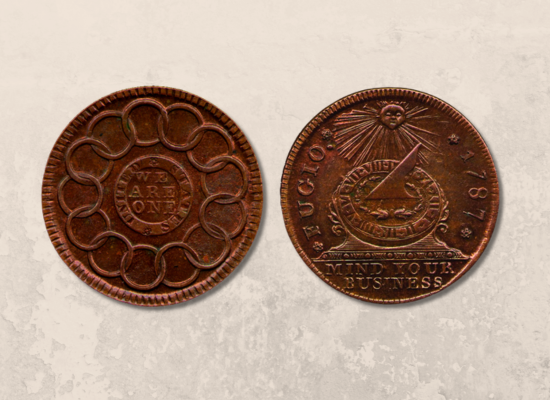
1787: The Fugio cent was produced as one of the first coins of the United States. Often credited as the first U.S. one-cent coin, this precursor to the penny is frequently attributed to Benjamin Franklin. The design featured thirteen linked rings representing the original colonies, the phrase “Mind Your Business,” under a sundial, and the word “Fugio” (Latin for “I fly”).
1792: The United States Mint was established on April 2, 1792, by Congress through the passage of the Coinage Act of 1792. It was located in Philadelphia, which was then the nation’s capital.
1793: The first official one-cent coin, known as the “large cent,” was struck. These early pennies were made of pure copper and were significantly larger than today’s coins, measuring almost as large as the modern half dollar.
1856–1858: The Flying Eagle cent was introduced, marking a shift away from large copper coins. It was smaller and made from a copper-nickel alloy (88% copper, 12% nickel).
1865: Congress authorized the motto “In God We Trust” for U.S. coins. It debuted on the two-cent coin that year and was added to the one-cent coin in 1909.
1859–1909: The Indian Head cent replaced the Flying Eagle design. Beginning in 1864, its composition shifted to 95% copper with tin and zinc, a formula that would remain in use for decades.
1909: The penny became the first U.S. coin to feature a real person (Abraham Lincoln) marking his 100th birthday. These early versions are known as Wheat pennies, named for the two wheat stalks on the reverse.
1943: During World War II, pennies were made from zinc-coated steel to conserve copper for the war effort.
1959: The penny’s reverse (backside) design changed to the Lincoln Memorial to commemorate Lincoln’s legacy. It replaced the wheat design.
1982: One-cent composition shifted again. Post-1982 pennies were made with 97.5% zinc with a thin copper coating.
2009: To mark Lincoln’s 200th birthday, the U.S. Mint released the Lincoln Bicentennial cents, a series of four designs representing different stages of Lincoln’s life.
2010–2025: The reverse design changed to the Union Shield, symbolizing Lincoln’s role in preserving the United States. It features a shield with 13 stripes representing the original colonies/states, topped with “E Pluribus Unum” (Out of Many, One). It was a popular, patriotic motif in the 1700s, particularly during the Civil War.
2025: The U.S. Mint announced a halt in new penny production due to rising manufacturing costs, though existing pennies remain legal tender and in circulation.
Fun Facts About the Penny
Unless you have a pocket full of pennies, you probably don’t think much about them. But behind that small coin is a mix of history, quirks, and contradictions.
1. It costs more than a penny to make a penny.
Penny production costs have exceeded one cent since at least 2006. According to the most recent estimate, the cost of producing each penny increased from 1.42 cents to 3.69 cents over the last decade.
2. The penny was once the most widely produced U.S. coin.
In the fiscal year before production ceased (2024), the U.S. Mint produced and shipped approximately 3.2 billion pennies, at a reported loss of around $85 million.
3. There are still a lot of pennies out there.
When production ceased in 2025, an estimated 300 billion pennies were in circulation. They remain legal tender, but many are likely sitting unused in jars, drawers, and piggy banks—or lost entirely. Some estimates suggest tens of millions of dollars in coins fall out of circulation each year due to hoarding, misplacement, or being discarded. This is partly because pennies have limited practical use, but also because restrictions on melting coins for their metal value make it harder to remove excess supply.
4. A “heads up” penny might bring you luck.
The act of picking up a found penny has long been believed to bring good fortune—unless, of course, that penny is face down. While the exact origin is unclear, the “heads” side became associated with luck and prosperity, while tails-up coins were thought to bring bad luck. The superstition has stuck around for generations. To this day, many people avoid touching or picking up facedown coins for fear of inviting bad luck.
5. Some pennies are worth far more than one cent.
While most pennies are only worth their face value, a few rare ones can be surprisingly valuable. Coins like the 1943 copper penny (accidentally struck during a year when pennies were supposed to be steel) or certain early-date and error coins have sold for thousands—or even hundreds of thousands—of dollars at auction.
6. Some of the final pennies produced are one of a kind.
In 2025, the U.S. Mint released 232 limited three-coin sets to mark the end of penny production—one for each year the coin was in circulation. Each set included two standard circulating pennies (from the Denver and Philadelphia Mints) and, for the first time ever, a 24-karat gold penny. These coins were struck with a special Omega (Ω) mark to signify the end of the penny’s 232-year run.
Small Change, Real Impact
Given their limited spending power, it’s easy to think of pennies as insignificant. But when you multiply them—over time, across purchases, and across a community—they tell a different story.
At Maps, that idea is built into our Penny-per-Swipe program through the Maps Community Foundation. Every time a member uses their Maps Free Community Checking debit card, we contribute a penny.
In 2025 alone, our members helped raise more than $150,000 just by using their debit cards for everyday purchases. Those funds then help support local schools, nonprofits, and community initiatives across the areas we serve. So, while the now-retired penny may not go as far as it once did, its value isn’t lost on us.
Want to learn more about where those Penny-per-Swipe funds go?
- See how our annual Teacher Grant program helps fund classroom projects, supplies, and creative learning opportunities for local educators.
- Explore our scholarship programs and how we’re supporting students as they take the next step toward their future.
- Learn how a 2025 grant helped The Reading Nest bring a Bookmobile to life, expanding access to books across our communities.
- Browse our recent Community Grants to see how we’re supporting nonprofits and local initiatives throughout the areas we serve.