
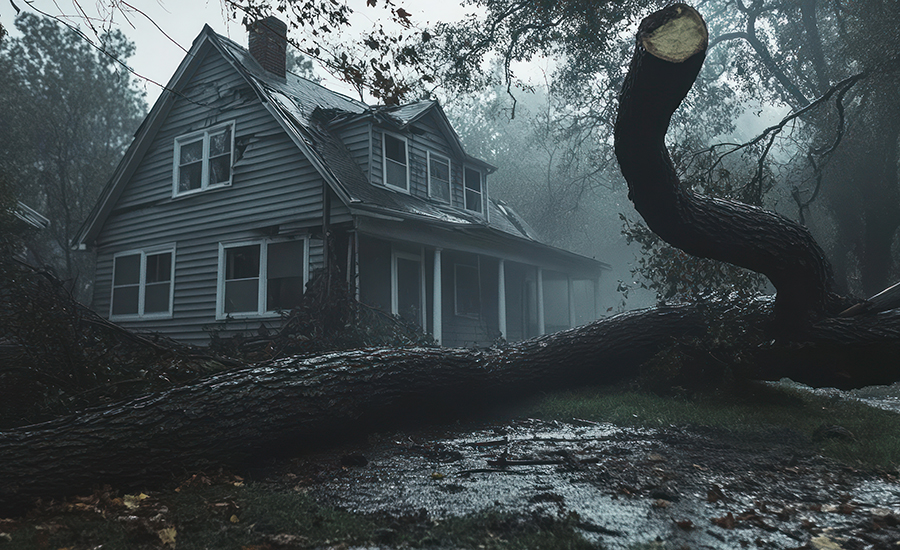
There’s a popular internet trend making the rounds that asks, “What were you like in the ’90s?” Back then, home insurance was a lot simpler—or at least more predictable. Policies often featured low, flat deductibles (typically just a few hundred dollars). You paid your premium, had a general sense of what was covered, and moved on.
But after decades of major hurricanes, wildfires, and other natural disasters, insurers began introducing separate, percentage-based deductibles for certain risks. That shift fundamentally changed how homeowners share in disaster-related costs.
Why Insurance Is Getting More Complicated
Insurance companies price policies based on risk. The higher the chance of a claim, the higher the cost to insure it.
That’s why, across the country, the rising risk of natural disasters is reshaping homeowners’ insurance. Higher risk drives up costs and, in some cases, makes coverage harder to find.
This shift is being driven by several factors converging at once. For one, natural disasters are becoming more frequent and more severe. At the same time, rebuilding costs have climbed due to labor shortages and rising material prices. And when entire regions are affected at once—like the Gulf Coast in 2005 with Hurricane Katrina—insurers face widespread losses that are harder to absorb and predict.
Together, these pressures force insurers to rethink how they price, structure, and offer coverage—especially in higher-risk areas. Some insurers are even stepping away from higher-risk areas altogether.
Wildfire Risk: A Growing Factor in the West
As many of us in the Pacific Northwest already know, wildfire risk has become one of the region’s biggest drivers of insurance changes. So, even if your home hasn’t been directly affected by a fire, your location likely plays a major role in how insurers assess risk.
They’ll look at factors like your proximity to forested areas, the local fire history, access to fire services and hydrants, and the defensible space around your home. But increasingly, they’re also looking at broader, community-level risk (a.k.a., how prepared an entire region or neighborhood is to withstand a wildfire).
Homes in higher-risk areas may see higher premiums, stricter underwriting requirements, or requests for property improvements, like clearing vegetation, upgrading roofing, or installing ember-resistant vents. In some cases, homeowners are seeing policies not renewed or coverage withdrawn altogether as insurers limit their exposure in fire-prone regions.
At the same time, there’s a growing push across the state toward wildfire mitigation and “home hardening.” Through community preparedness programs (like Firewise), neighbors are creating defensible space and incorporating fire-resistant materials into both new construction and existing homes. The goal is, of course, to reduce damage, but also to demonstrate to insurers that entire communities can better withstand wildfire risk.
These efforts show promise, but they don’t always lead to immediate savings. In many cases, insurers are still waiting for long-term data before offering meaningful discounts or expanding coverage options. So, for now, wildfire risk remains a key factor shaping both the cost and availability of homeowners’ insurance across the West Coast.
Flood Risk: What Standard Policies Don’t Cover
One of the biggest misconceptions in homeownership is that standard homeowners’ insurance covers flood damage. It doesn’t. In most cases, coverage for water damage depends on three key factors: the type of policy, the source of the damage, and whether the damage occurred suddenly or developed over time.
Flood insurance is typically a separate policy, and it is often required for homes in designated flood zones. But even homes outside those zones can flood due to heavy rainfall, rapid snowmelt, drainage, or infrastructure issues. So, if you’re relying on your regular policy, it’s worth double-checking what’s actually included.
Earthquake Risk: Often Overlooked, Rarely Included
Like flood insurance, earthquake coverage is usually not included in most standard homeowners’ policies. Earthquake insurance is optional, and not everyone chooses to carry it. In Oregon, only about 20 percent of homeowners carry earthquake coverage—and that leaves many households financially exposed in the event of a major quake.
While major earthquakes aren’t common, Oregon is part of the Ring of Fire, a horseshoe-shaped zone responsible for most of the world’s earthquakes and volcanic activity. More specifically, this region also sits near the Cascadia Subduction Zone, which is considered “overdue” for a major (7.1+) earthquake in the next 50 years.
Other Factors That Affect Your Premium
Your insurance risk isn’t just about where your home sits. Other factors, like your home’s condition, can influence your insurance costs.
When you buy a home, insurance company actuaries and underwriters look closely at the age and condition of major systems like the roof, electrical, and plumbing. They also assess overall upkeep and building materials, since some are more resistant to fire or water damage than others. Safety features—like alarm systems, fire-resistant landscaping, or updated systems—can sometimes help lower costs.
They may also review your personal claims history, as well as the property’s history. A pattern of previous claims, particularly within the last five years, can lead to higher premiums.
Pets are another factor, as certain dog breeds can influence your premiums, coverage options, and eligibility. Features like swimming pools, trampolines, or even certain types of fencing can also increase liability risk, which may affect your coverage and costs.
How to Protect Yourself (Without a Wildly High Premium)
Insurance may be getting more complex, but there are still ways to stay ahead of it.
1. Review your policy annually.
Costs and risks change. So, don’t assume your coverage still fits your needs. Once a year, ideally around your policy renewal date, review your coverage to make sure your family and belongings are protected. You should also review your policy whenever you have a major life event, like remodeling, marriage/divorce, retirement, or starting a business.
2. Ask your insurance company direct questions.
Don’t assume you know what your policy covers. Ask what’s excluded, what coverage limits apply, and how your policy would respond in a worst-case scenario. A quick conversation now can help you spot gaps before they turn into costly surprises.
3. Consider additional policies
Standard homeowners’ insurance doesn’t typically cover everything. So, depending on your location and comfort with risk, it may be worth exploring additional coverage (like flood or earthquake insurance). These policies can help fill gaps and provide protection where your base policy falls short.
4. Invest in mitigation
Taking steps to reduce risk can make a difference. Clearing defensible space, upgrading to fire-resistant materials, or improving drainage around your home can help protect your property—and may even help with insurability over time.
5. Shop around
Rates and underwriting standards can vary widely between insurers, especially in higher-risk areas. So, it’s worth comparing options to find coverage that fits your needs and budget. Working with someone local (like Maps Insurance) can make it easier to shop across multiple carriers and find a policy that actually fits your situation.
Home insurance still does what it’s meant to do—protect your home—but the details matter more than they used to. That’s why taking the time to review your options and ask questions is so important. By making informed choices now, you can (potentially) avoid costly surprises later—and feel more confident in the coverage you have.
Want to learn more?
- Separate fact from fiction with 11 home insurance myths that could cost you.
- Learn which home maintenance projects have the best long-term return.
- Find out how to finance (and build) an ADU in Oregon.